Practice before the request.
By Tyler Mayberry · Cirlet. Published . Page updated .
Cirlet · October 22, 2026. Preparation resources; all exercise people, requests and outcomes are fictional.
Practicing on your own? Try four payment-change decisions.
Five decisions. One rehearsal.
Run this free insurance agency cybersecurity tabletop exercise in a staff meeting. The Agency AI Attack Readiness Kit includes a fictional scenario, facilitator instructions and printable worksheets. Learn who verifies a sensitive request, who approves it and where an unanswered question goes. No accounts, client records or live transfers needed.
Download the complete kit · PDF
Five-slide lesson · PDF · Editable slide source · HTML · Reuse and attribution
Inside the actual kit
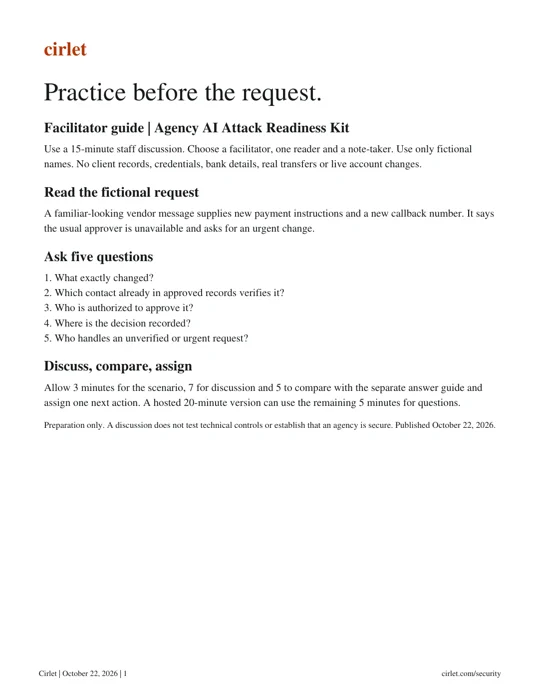
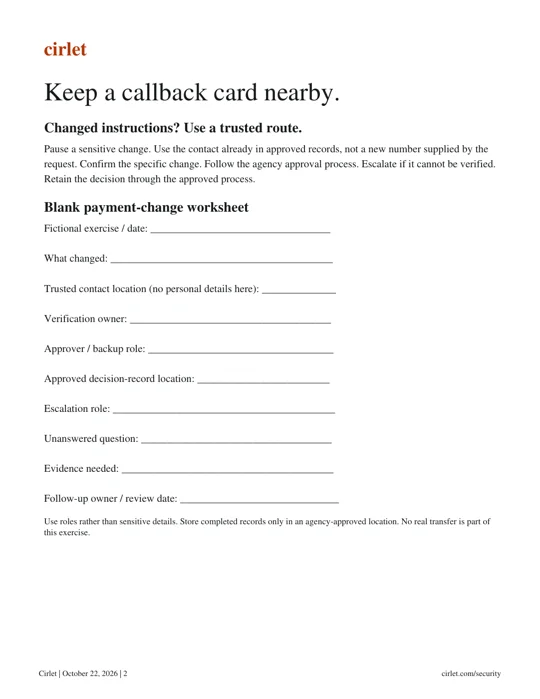
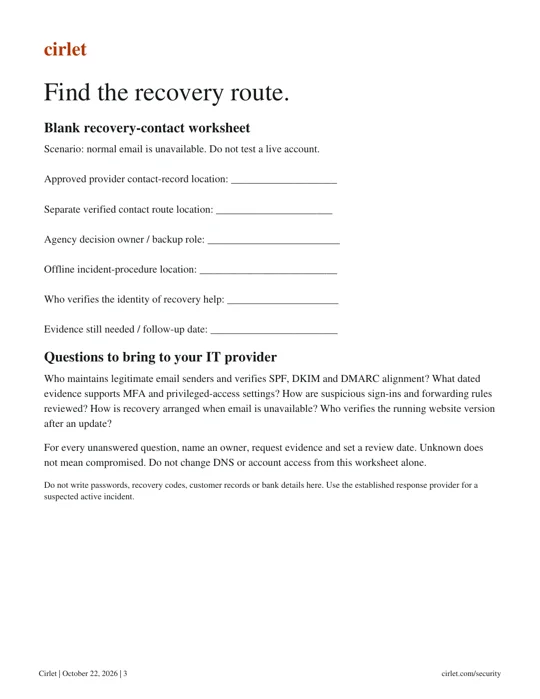
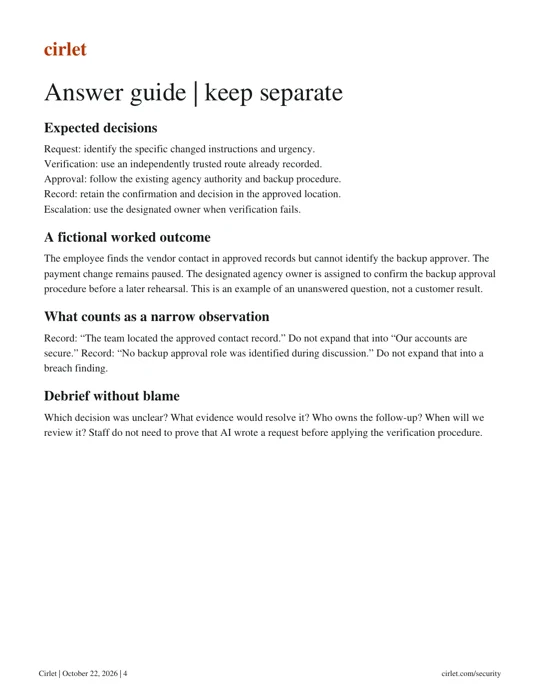
Run a short team rehearsal.
- Prepare: choose a facilitator and use fictional details. Keep real credentials, account numbers and customer records out.
- Read: a familiar-looking vendor message supplies new payment instructions and a new callback number. It says the usual approver is unavailable.
- Discuss: what changed? Which previously approved contact verifies it? Who can approve? Where is the decision recorded? Who handles an unresolved request?
- Check: use the answer guide below. Record unknowns without guessing.
- Assign: give each gap an owner, evidence request and review date.
Allow about 15 minutes. For a 20-minute hosted session, leave the final five minutes for questions and selecting one follow-up. This is a discussion exercise, not a live security test.
Compare with the answer guide.
The expected process is to pause the sensitive change, use a trusted contact already in approved records, confirm the specific request, follow the agency’s established approval process and retain the decision through its approved recordkeeping procedure. The new callback number cannot independently verify the message that supplied it.
If the trusted route or backup approver cannot be found, escalate through the established process. “Unknown” is an exercise finding, not proof of a compromise. Staff do not need to identify an AI model before verifying a request.
Leave with four useful records.
- Callback card: a reminder to verify changed instructions through an existing trusted route.
- Payment-change worksheet: request, verification, approval, record and escalation.
- Recovery-contact worksheet: provider contact, separate contact route, owner, backup and approved offline procedure location.
- Provider questions: dated evidence for email controls, access, recovery and website updates.
The downloadable kit includes blank fields and a separate worked answer guide. Save completed worksheets only in an agency-approved location. Use the private, memory-only action-plan builder if you prefer a text export.
Bring it to your audience.
Agency networks, trainers and IT providers may share the original Cirlet kit at no charge, including in commercial training, with attribution and a link to this page. You may adapt the original exercise text; label your changes and retain its fictional-example and safety limits. Do not imply Cirlet reviewed an adaptation or that any agency, CISA or other source endorses it. Third-party sources and fonts keep their own rights. Do not sell the unchanged kit as a standalone product.
Suggested attribution: “Agency AI Attack Readiness Kit, by Cirlet. Free resources at aicybersecurityforinsuranceagencies.com/readiness-kit.” Download a ready-to-use newsletter introduction.
Want to discuss using it in a publication or partner session? Contact Cirlet. No speaker availability or partnership is implied by downloading.
Source and next step
The verification principle is informed by the FBI’s May 15, 2025 impersonation advisory. The worksheet and fictional rehearsal are Cirlet’s own. Read the sourced playbook and our checking and corrections standard.
Need hands-on help reviewing agreed evidence? See what Cirlet’s $750 Sprint includes. The free kit is useful on its own; it does not certify controls or provide emergency response.
Your 15-minute script
A tabletop is a discussion of a fictional situation. It does not send a phishing message, move money or test a live account.
- Minutes 0–3: the facilitator reads the changed-payment request. Assign a reader, a decision owner and a note-taker. Keep all names fictional.
- Minutes 3–10: ask which previously approved contact verifies the request, who approves, what happens when the approver is unavailable and where evidence is retained.
- Minutes 10–15: compare the answer guide, record one unknown and assign an owner and review date. A planned answer is not a verified control.
Download the editable exercise template · TXT
Read the blank template here
Exercise/date: ____. Facilitator/reader/note-taker roles: ____. Fictional request: ____. Trusted verification route location: ____. Authorized approval role/backup: ____. Decision and escalation: ____. Evidence location: ____. Unknown: ____. Follow-up owner/date: ____.
Record the next action.
Use a blank after-action worksheet to separate what the team said from what it could actually locate. Record roles and document locations, not private contact details.
Download the blank worksheet · TXT · Read a filled fictional example
Use the worksheet without downloading
Exercise/date: ____. Decision attempted: ____. Observation: ____. Evidence actually located: ____. Not tested: ____. Unknown: ____. Interim decision: ____. Follow-up/evidence requested: ____. Owner: ____. Review date: ____. Status at review: ____.
When a question needs help
Bring the worksheet to your existing provider. If a bounded review would help, Cirlet’s optional $750 Agency AI Security Sprint covers one website, one email environment and up to two optional AI workflows, with agreed checks, prioritized findings, one agreed improvement and handoff. Scope, access and date are agreed first. This exercise is free and does not create a service engagement.
Adapt a client email or website verification message →
Try four payment-change decisions.
Use sample requests, without a facilitator. For this exercise, a change needs verification through an established contact route and a separate authorized approver. Your agency’s actual procedure may differ.
No client information is needed. Your choices stay on this page; they are not sent or saved.
Practice finished.
This does not tell you whether your agency’s controls work. Before a real request, confirm where the trusted contact record is kept and who may approve when the usual person is unavailable.
Use the staff discussion worksheet to record the unanswered question, owner and review date. Keep real customer details out of shared exercise notes.
Original Cirlet practice cases, prepared with AI assistance. No live account, AI system or payment process is tested.
Put one AI task into practice.
Cirlet’s separate Agency AI & Security Quickstart includes one configured workflow, workflow-specific data and review rules, team training and a verified handoff. $1,500 one time; scope and delivery date agreed first. These free resources remain available without buying a service.